
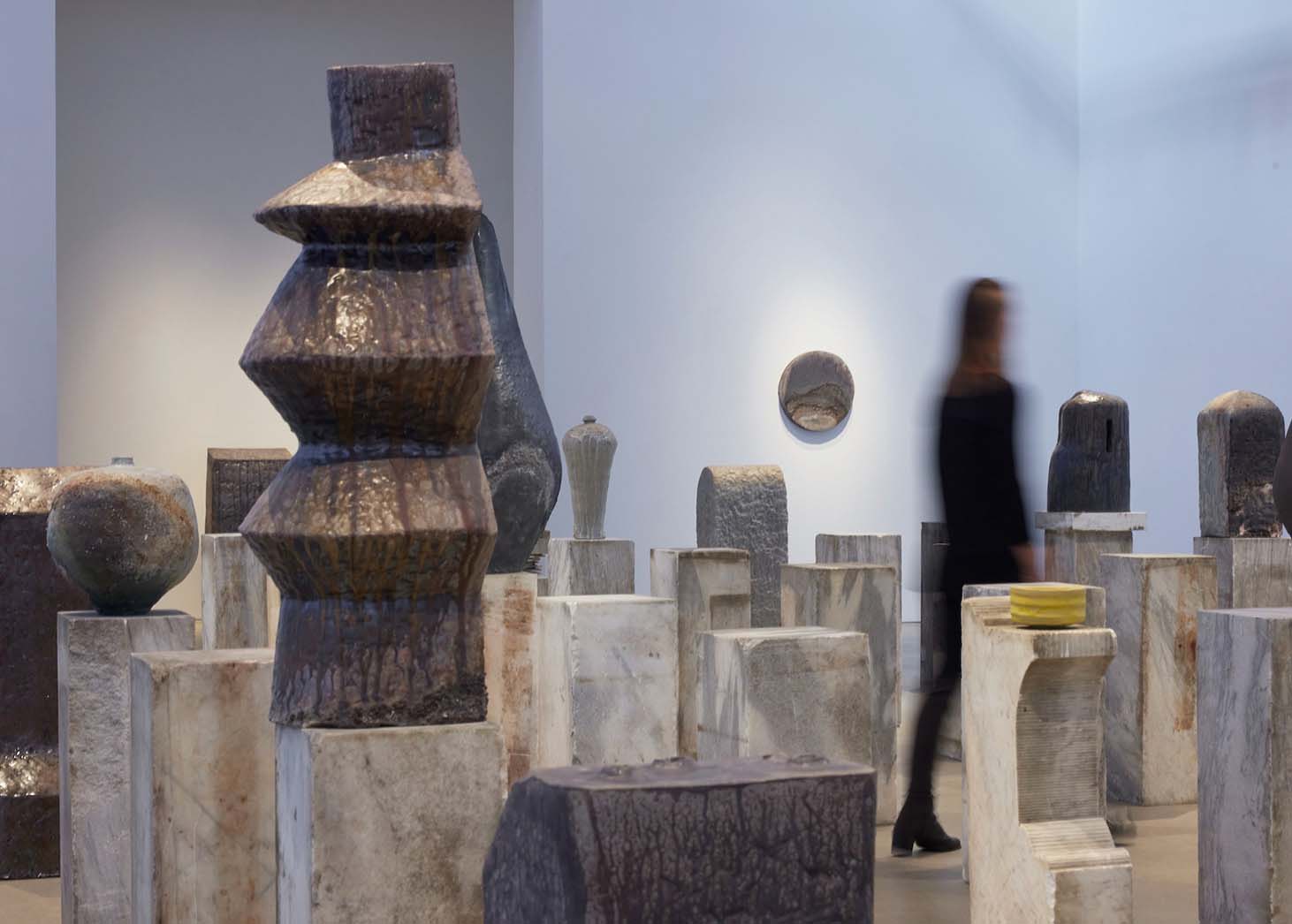
Theaster Gates is a potter, a poet, a performer, and a social practice artist, and he has a beautiful voice. Born and bred in Chicago in 1973, Gates has made a name for himself on the international art stage and has a chest full of blue-chip awards, grants, and residencies. In 2025, his home city awarded him two solo, simultaneous exhibitions. Unto Thee opened at the Smart Museum of Art at the University of Chicago in October 2025. As a professor in the Department of Visual Arts, Gates is the self-appointed guardian of “discarded and no longer needed university materials,” and his collection of artifacts from the university’s archives fills the museum’s lobby floor to ceiling and continues into the adjoining room.
OH, YOU HAVE GOT TO COME BACK TO THE CITY, the title of Gates’ sixth exhibition with the Gray Gallery since 2016, comes from City Promenade, a poem by his fellow poet and musician friend, Marvin Tate.
Oh, you’ve got to come back to the city, the place where you belong
Oh, you’ve got to come back to the city, the place where you were born
Oh, you’ve got to come back to the city, the city of dreams- Marvin Tate, City Promenade
In all of Gates’ prodigious installations from the US to Europe and Asia, the ceramic vessel is a main character. After studying ceramics at Iowa State University (1996), he sharpened his skills with a master potter during a year-long residency in Tokonoma, Japan, a famous potter’s village. It was an awakening year for the artist. He reflects, “[…] by channeling the earth the potter learns how to shape space…how to shape the world.”
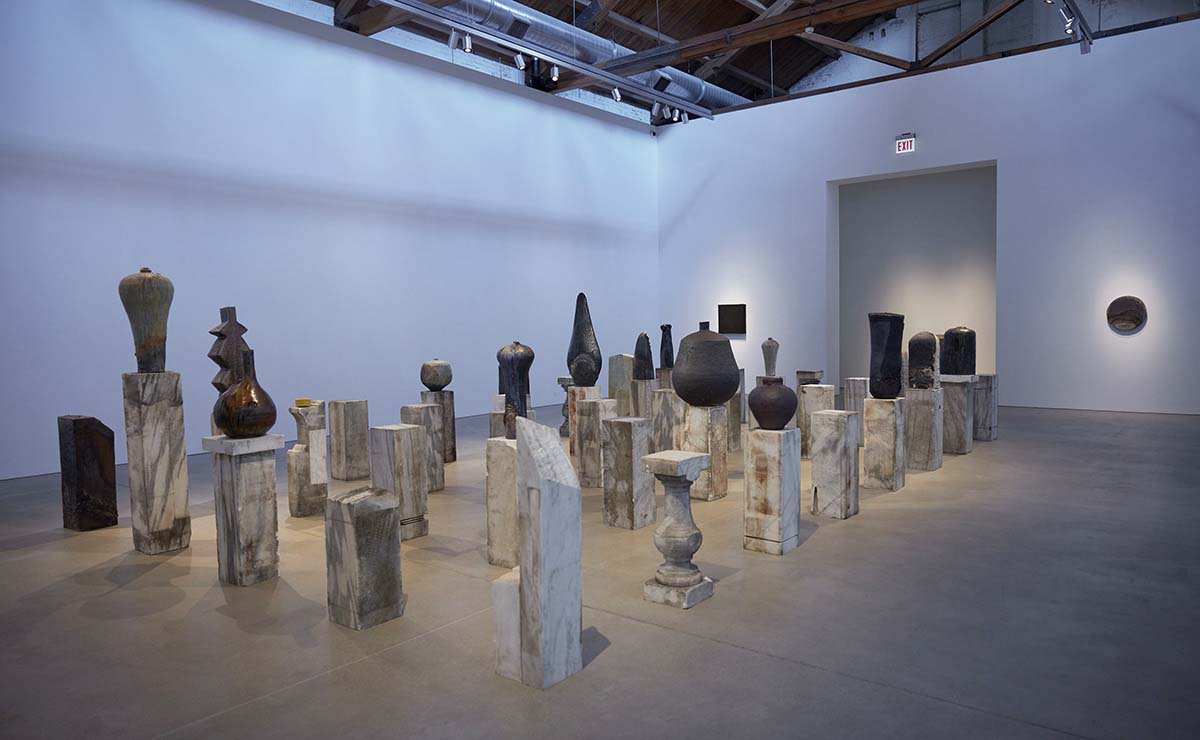
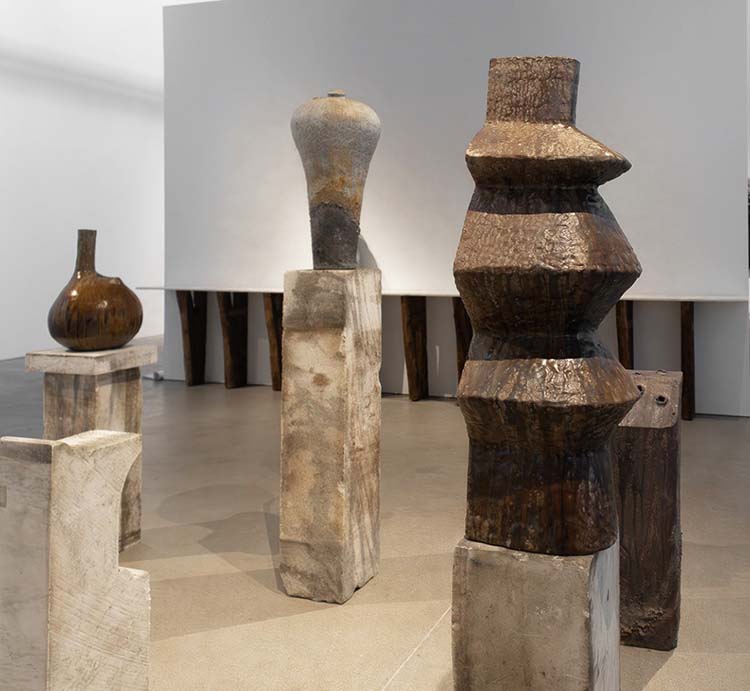
Asked about his recent exhibition, “[…] my show at Gray Gallery is in three parts: tar, ceramic, marble.” Four large tar-, bitumen-, and rubber-covered canvases hang on the walls of the front space. In the large back space, forty free-standing plinths are arranged in eight rows, five deep. Thirty-six are marble; one is a Classical balustrade. Four rectangular, forty-inch ceramic plinths are marker-like. The unique marble plinths are beat up, showing wear and tear, with pencil markings, several “cut into” with a blade. Gates collected these from a construction site in Wisconsin.
Forty is a significant number. It is quoted in the Bible, in both the Old and New Testaments. In Egyptian mythology, forty is a “generation,” and the number represents “completion” and “wholeness.”
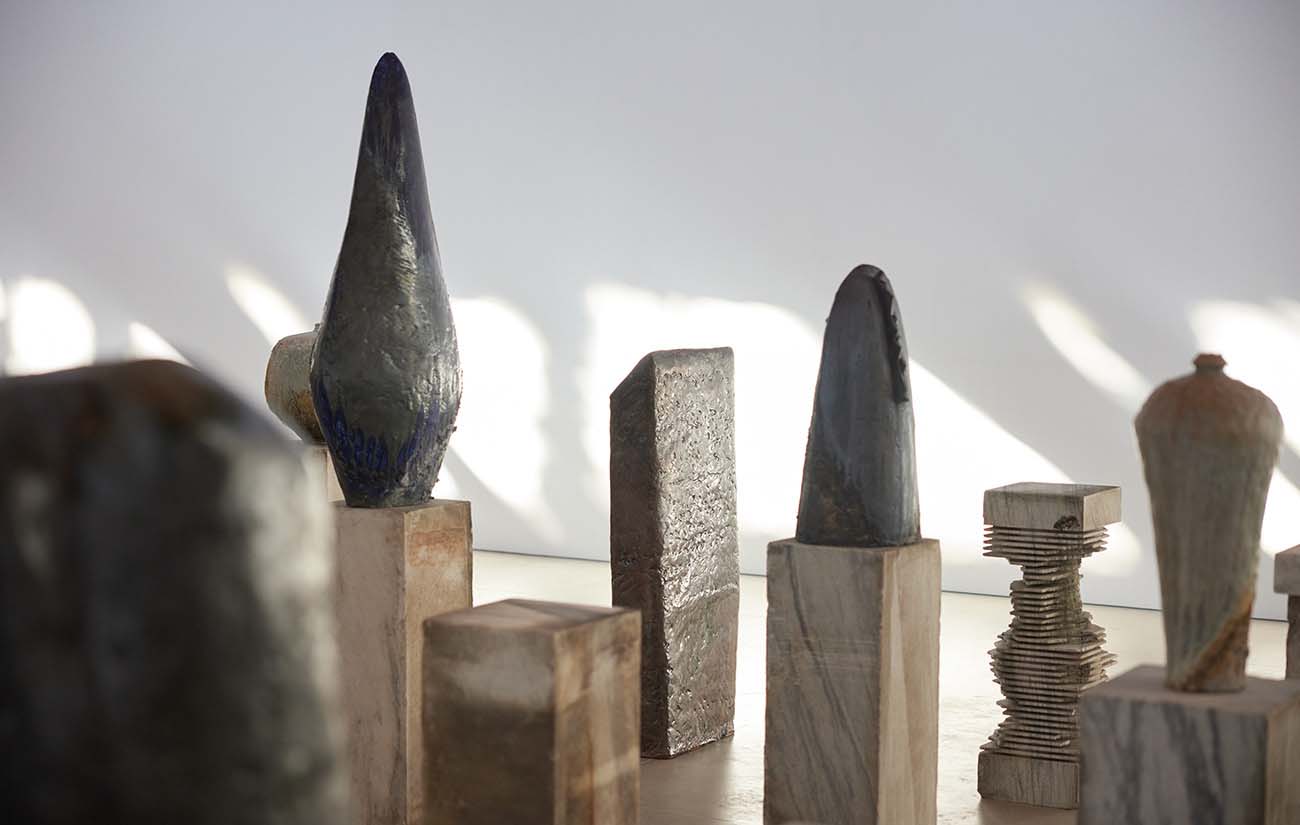
Gates’ installation at the Gray Gallery looks like an urban grid. It is rational and formal, beckoning a grave site or memorial, suggesting “remnants left behind by former inhabitants.” This spatial logic reflects his long-standing engagement with urban planning, where the city becomes not just a built environment but a “moral and imaginative terrain.” Across his work, he contends with “Black space as a formal exercise,” asking what it means “to dwell amid the remains of lives once lived but now forgotten.” His projects are grounded in the belief that art and culture can revitalize what has been lost. Gates’ pots hold the souls of those who have come before.
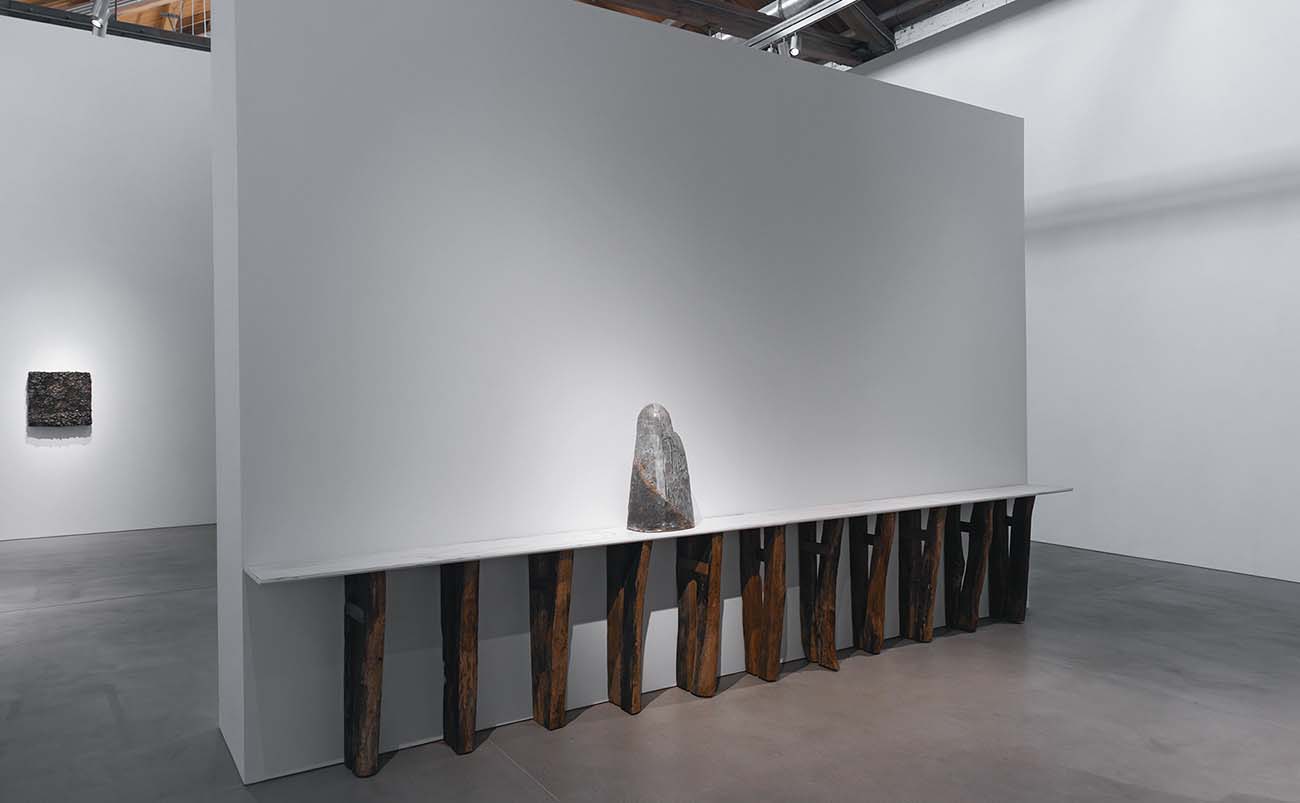
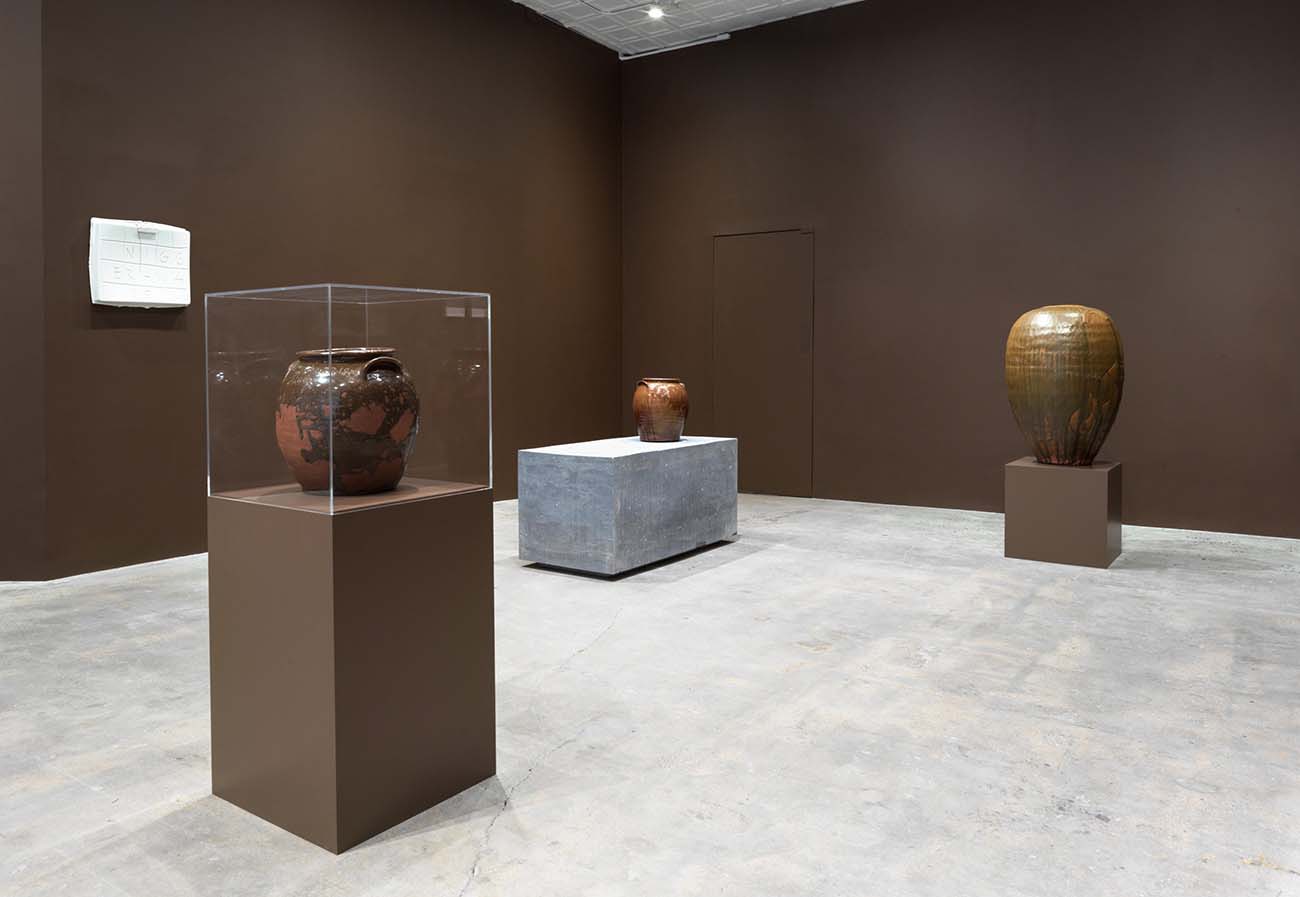
Individual ceramic forms guard the entrances to the space. Along the south wall, Table Mountain is placed at the center of a long marble table supported by eleven reclaimed wood legs. Statuary of Home guards the north entrance. All the stoneware forms and pots were fired in a wood-burning kiln, several of which have a generous accumulation of wood ash on their surface. My friend, an architect, asked how he colored the pots and forms. I explained that the surface was a gift of the fire.
There are three remarkable vessels that stand out in this forest of pots. Brother’s Palace looks like one of Constantin Brancusi’s carved-wood bases placed atop a marble plinth. A zigzag runs down the vessel’s front, with a flat side at the back that is both unexpected and arresting. It is not a new shape; he has used this atypical form in earlier installations.
Udu has one of the great bellies of all time. The wood ash glaze cascades over and down its capacious surface. “Udu” is a traditional Nigerian percussion instrument—in the Ibo language, the word means “pottery.” The instrument typically has a hole in the side so it can be played as a drum. Gates’ pot has no hole; the only opening is at the top of the off-center neck.
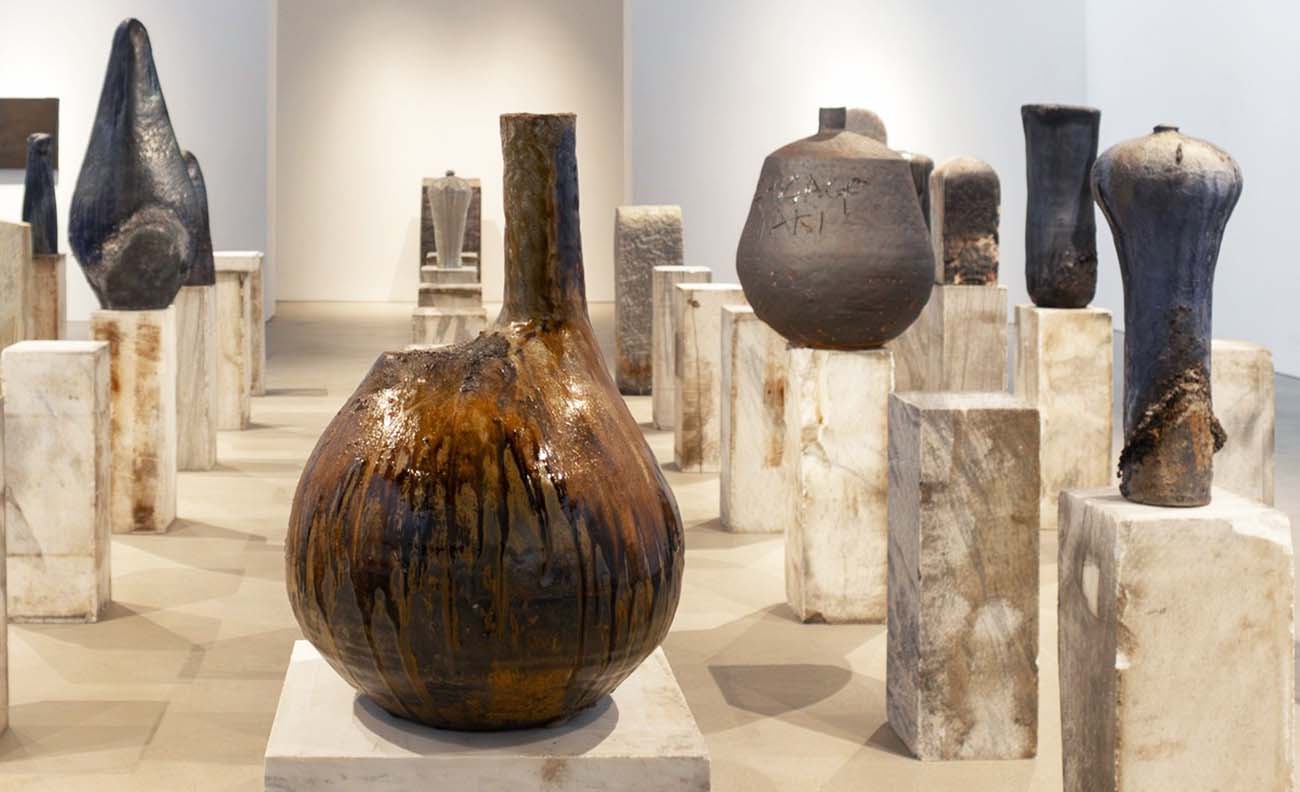
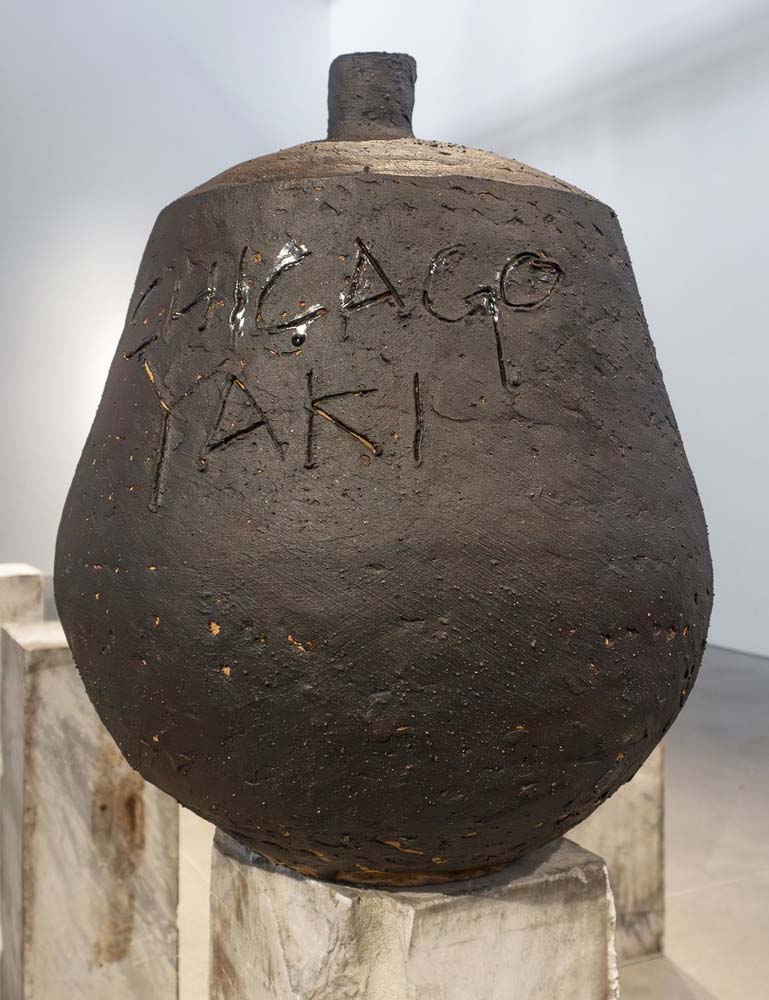
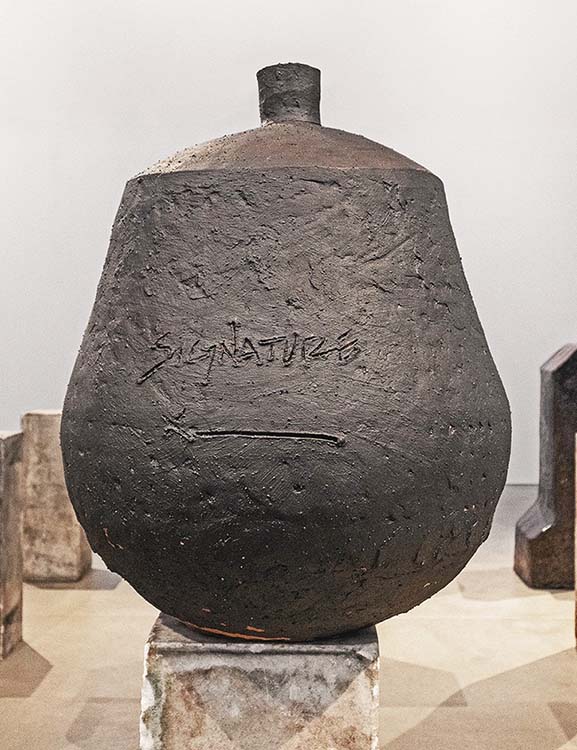
The most arresting pot in Gates’ “grid” is Chicago Yaki. It is heroic: large, with a low belly and a flattened, shallow, dish-like shoulder. “Yaki,” in Japanese, is a term for “grilled” or “to burn.” The surface is a matte, unglazed, deep chocolate brown. On one side of the pot, Gates has engraved “CHICAGO YAKI”; on the other, “Signature.” It is underlined!
“Signature” on Gates’ pot is no name or every name. Importantly, it points to his interest in the Mingei movement, an aesthetic of Japanese folk crafts produced by nameless artisans. Mingei honors the art of the everyday and resists the forces of Modernism and Western assimilation in mid-20th-century Japan. Chicago Yaki is no day-to-day pot. By engraving “Signature,” Gates channels “the beauty of the unknown craftsman.”
A potter’s mark or backstamp is important. It is the hand’s last touch. “Woha,” I said to myself. I could only think Gates was channeling Dave Drake the Potter (1800-1865). Drake was enslaved in Edgefield, North Carolina, where, at that time in America, enslaved people were not allowed to be schooled. Dave not only signed his name but also inscribed lines of poetry on the lips of his four-gallon ash-glazed storage jars.
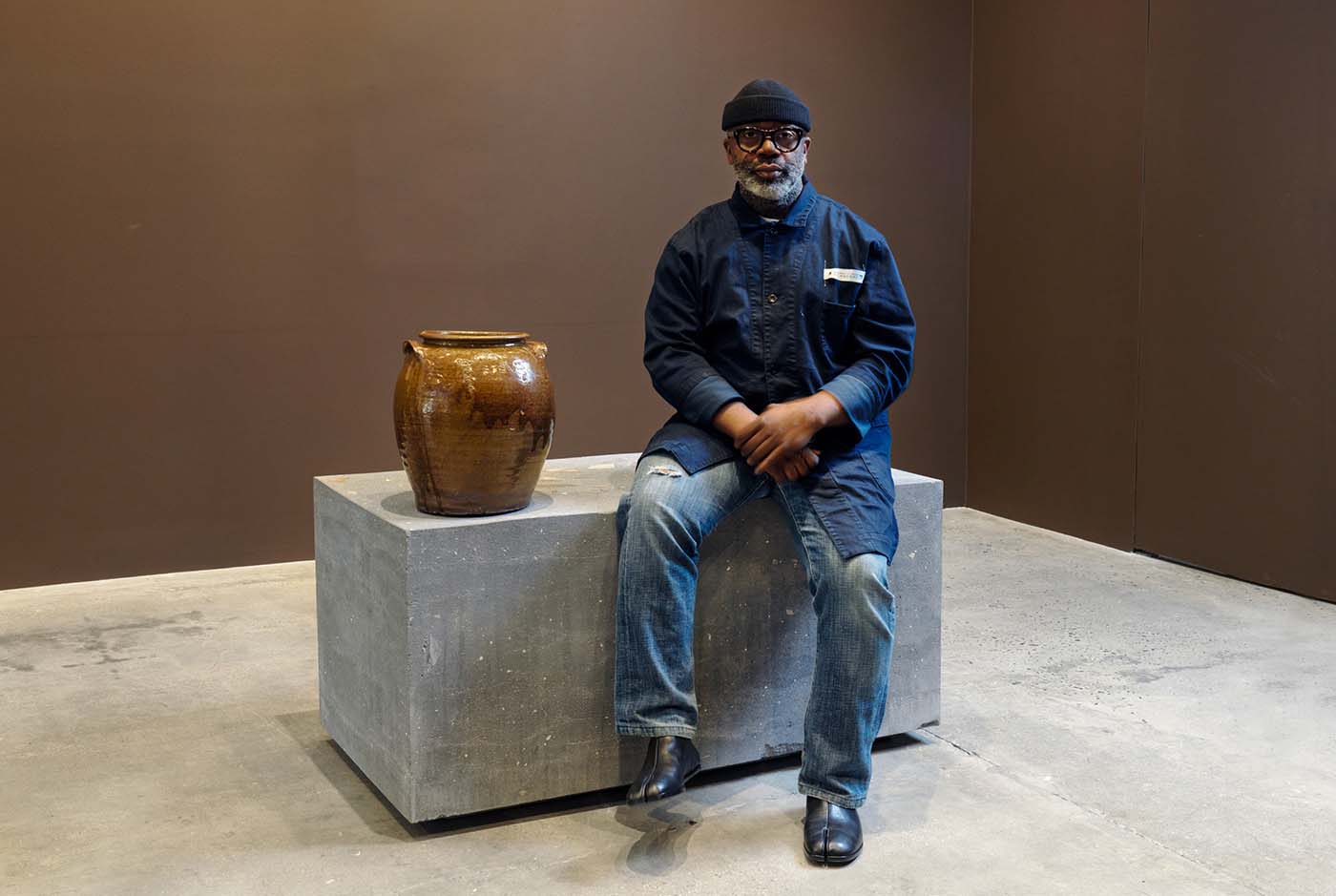
As the spirits would have it, at the time of this writing, Theaster Gates and David Drake are brought together in the exhibition Dave: All My Relations at Gagosian Gallery, curated by Gates and on view through May 2. David Drake’s heirs have established the “Dave the Potter Family Trust” and have called for the restitution of all 600 of Dave’s pots from museums and private collections. Gates is returning the two Dave pots he owns. In keeping with his personal philosophy, he is quoted: “This object represents an opportunity of joy transference.”

Mary Seyfarth often describes the ceramic vessel as a passport that has guided her practice and perspective. For her, throwing a pot is a personal act of discovery, while teaching ceramics is an exploration of science, art, aesthetics, and world cultures. Writing about ceramics and the vessel in particular further refines her eye.

Her work is grounded in strong forms and clean lines, drawing inspiration from the strength of ancient and medieval functional vessels. At the same time, her direct engagement with medieval Byzantine ceramics through handling, excavation, replication, and writing has expanded her sensitivity to the expressive voice of decoration. WEBSITE